
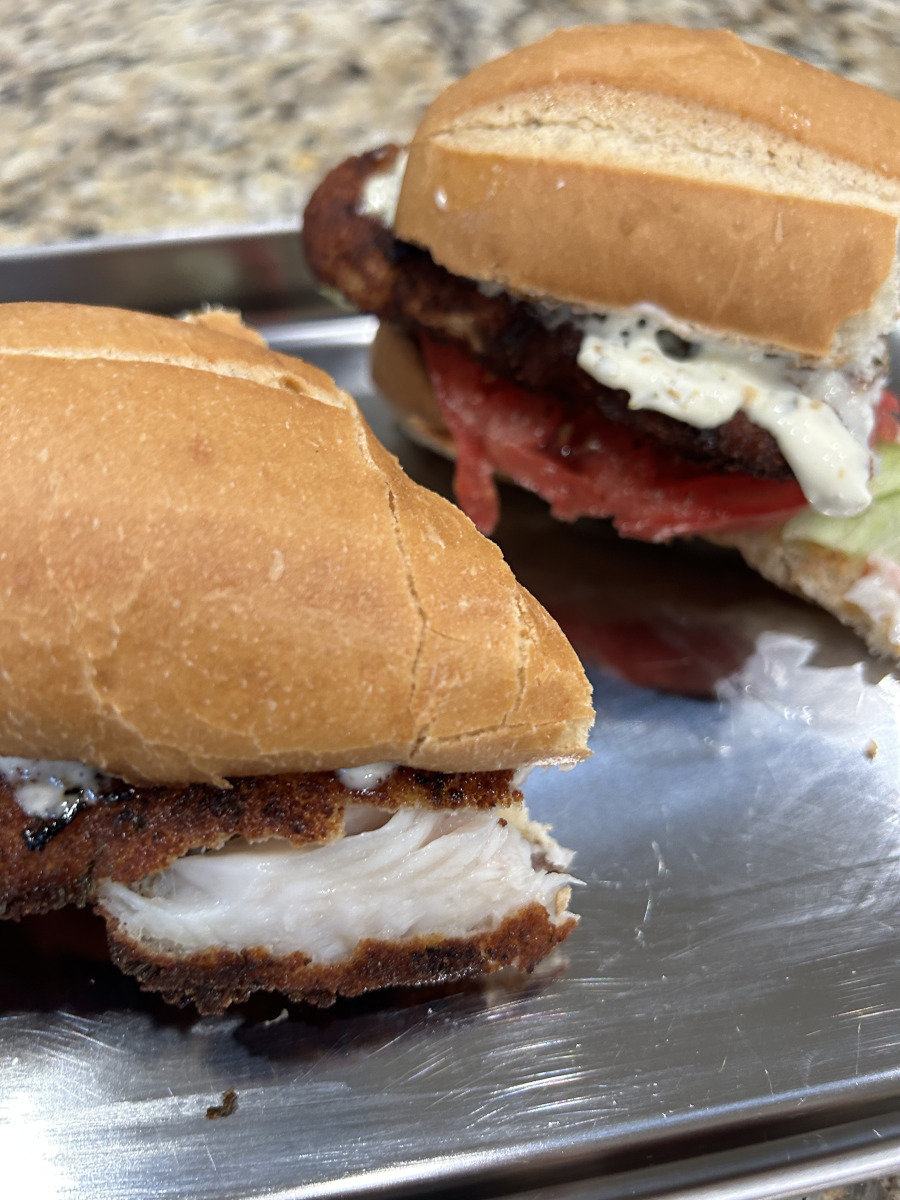
A Flounder Po’ Boy is a delicious sandwich. Flounder has a sweet, delicate white meat. When lightly breaded and fried with a hint of lemon, it tastes amazing. Combine this with shredded cabbage, ripe tomato, tangy tartar sauce and a toasted hoagie roll to make sandwich perfection.

Flounder Po’ Boy

Equipment
- small mixing bowl
- large skillet
- spatula
- cutting board
- kitchen knife
- paper towels
- wire whisk
Ingredients
- 4 small flounder fillets
- 1 egg
- 2 tsp cornstarch
- 1 lemon – zested and juiced
- 1 cup bread crumbs
- 1 tsp dried parsley flakes
- 1 tsp kosher salt
- ¼ tsp black pepper – ground
- 4 tbsp olive oil
- 4 po' boy rolls – split
- 1 cup lettuce or cabbage – shredded
- 1 tomato – thinly sliced
- 1 cup Tartar Sauce
- 4 dash Tabasco Sauce
Instructions
- Rinse flounder fillets in cold water, and pat dry with a paper towel.
- In a small mixing bowl, gently whisk together the egg, cornstarch, lemon juice, and lemon zest.
- In a shallow dish, combine the bread crumbs with the parsley flakes, kosher salt, and ground black pepper.
- Dip the flounder fillets into the egg mixture and place them into the bread crumb mixture to coat.
- Heat olive oil in a large skillet over medium heat until shimmering. Sauté the fillets for 3-5 minutes, turning once, until golden brown. Remove to a paper towel to drain.
- Drizzle a small amount of olive oil onto the tomato slices, then sprinkle with kosher salt and pepper.
- Lightly toast the Po' Boy bread. Add shredded lettuce or cabbage tossed in Tartar sauce, tomato slices, the flounder fillets, and a squeeze of lemon with a few dashes of Tabasco.
Notes
PRIVATE NOTES
Nutrition
More Information
Fishing for Flounder Po’ boys
I once owned a house on the shore of Carancahua Bay, part of the Texas Matagorda Bay system. One day I pulled up to the dock in my boat, and noticed a fisherman cleaning his catch. I walked up to see that he had a nice limit of flounder in the cooler. He would clean two fillets off the top, then throw the carcass in the water.
I was shocked! I guess he didn’t realize that a flounder has 4 fillets, two on the top, and two on the bottom. The belly meat is delicately delicious, and often overlooked. I asked the man, “Hey – do you mind if I take those flounder carcasses to bait my crab traps?”. He said, “Sure, go right ahead!”. I went home with four half-filleted flounders, promptly finished them off and had Flounder Po’ Boys for dinner! We ate well that night, I tell you what! Ayeee!
How to Fillet a Flounder
Filleting a flounder is simple in concept, but tricky in execution. Its good to be prepared with a very sharp boning knife about 8″ long, a honing tool, a large cutting board, and cool running water to keep things clean.
It’s important to mention that there are several acceptable methods to fillet a flounder. I’ll describe the method I use, which I find to be efficient and does not waste any precious meat. With practice, you might alter this method to suit your style.
Let’s Begin
Lay a freshly rinsed and dried flounder flat on a cutting board with the head facing to your left. Make your first cut diagonally from the top of the flounder starting just behind the head, and passing just behind the pectoral fin all the way to the vent. This should be a relatively straight cut, all the way through the fish, completely removing the head and gills.
Discard the head, gills, and viscera, then rinse the fish clean with cool water. Cutting through bone will dull your knife quickly, so rinse your knife and give it a couple of strokes with a honing tool.
Now, make a clean cut along the lateral line all the way to the tail. Do not cut all the way through the fish, but allow your knife to glide just above or below the backbone ridge, and cut all the way down to the rib cage.
With the blade angled toward you, and using the tip of your knife, make long cuts that run parallel to the lateral line, and remove the meat from the rib cage as you gently pull it back with your free hand. Flounder meat is very delicate and easy to bruise, so be careful not to damage the meat.
Be Careful!
Be very careful making this cut because your free hand is exposed to the sharp edge of your knife. Allow the tip of your knife to pierce through the skin just inside of the skirt at the bottom of the fish. Cut the flesh away from the bone along the top of the lower skirt line all the way toward the tail, but do not cut all the way through at the tail. If you do this properly, there should be little or no meat left above the exposed lower rib cage, and the fillet should still be attached at the tail.
Flip the meat over at the tail so that the skin side is down, and the fillet is positioned from left to right. Rinse your knife and give it a couple more strokes of the honing tool.
Carefully cut through the meat at the tail, but not all the way through the skin. Use your left hand to keep the fish from sliding. With a moderate downward angle of the knife blade make a single clean decisive cut from left to right to remove the fillet from the skin. This can be tricky because the skin is very thin and easy to cut through.
Finish the Job
Repeat this process to on the top and back of the flounder to complete the job. When you are finished, you will have four fillets. Rinse them in cool water, then pat them dry with a paper towel. You can place them in a plastic zip lock bag and keep them in the refrigerator if they will be consumed within a day or two. Otherwise, use a vacuum sealer and put them in the freezer where they will keep for a couple of months.
Related Recipes
Tartar Sauce

Cajun Red Sauce

Spicy Creole Remoulade

Bacon Fried Trout

Margarita Marinade for Seafood

Blackened Fish or Chicken

Care to comment? I'd love to read it. Please be cool, respectful, relevant, positive or constructive, and leave an actual comment. Thanks!