
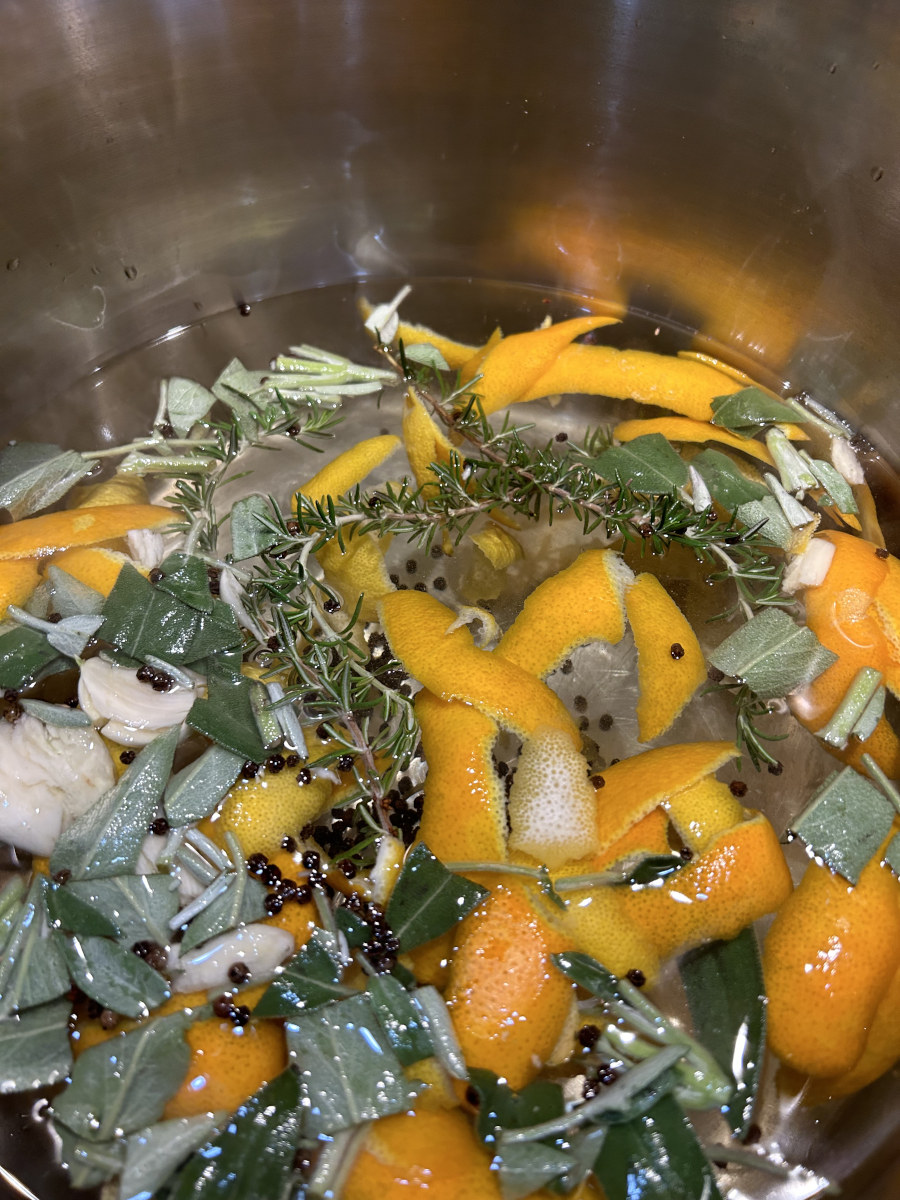
Citrus Poultry Brine infuses chicken or turkey with mildly zesty flavors of orange, lemon, herbs, and garlic. It tenderizes and moisturizes your poultry so that it stays juicy when roasting it. Use it when making Smoked Turkey Breast, or Roasted Chicken for perfect, moist deliciousness.

Citrus Poultry Brine

Equipment
- 1 large sauce pan
- 1 vegetable peeler
- 1 kitchen knife
Ingredients
- 3 oranges
- 3 lemons
- ½ cup sage leaves – fresh
- 2 bay leaves
- 1 tbsp peppercorns – whole
- 5 cloves garlic – large, peeled and smashed
- 4 quarts water
- 1 cup kosher salt
- 2 sprigs rosemary
Instructions
- Strip the peels from the oranges and lemons using a vegetable peeler. Try to remove just the peel, leaving behind as much of the bitter white pith as possible. Roughly chop the sage leaves. Make sure the bay leaves, peppercorns, and garlic cloves, and rosemary are measured out and ready to go.3 oranges, 3 lemons, 1/2 cup sage leaves, 2 bay leaves, 1 tbsp peppercorns, 5 cloves garlic, 2 sprigs rosemary

- Bring 1 quart (4 cups) of the water to a boil in a large saucepan or stock pot on the stovetop.4 quarts water

- Once boiling, add the salt and stir until dissolved.1 cup kosher salt

- Add the orange and lemon peels, chopped sage, bay leaves, peppercorns, rosemary, and garlic. Let the water return to a boil, then remove from heat.

- Let the brine concentrate cool until no longer steaming, then stir in the remaining 3 quarts of water. Check the temperature of the brine; it should be room temperature or lukewarm.

- Add 4 cups of ice to the solution to cool it even further.

- Remove the poultry from its package and pat dry. Remove the giblets and save for making gravy. Place the poultry in a large pot, brining bag, or other container large enough to keep it submerged. Pour the brine over the poultry. Make sure the poultry is submerged, though it's ok if the boney tips of the legs stick out the top. If needed for larger turkeys, prepare additional brine solution (1/4 cup of salt dissolved in 4 cups of warm water) in order to cover the turkey. If the poultry is floating, weight it down with a plate or other heavy object.

- Brine for 12 to 24 hours. Cover the poultry and keep refrigerated during the brining process.


Notes
- Save the leftover oranges and lemons for stuffing the poultry during roasting!
PRIVATE NOTES
Nutrition
More Information
What is brining? Can you nerdsplane it for me?
Brining is basically soaking meat in a hypertonic solution. This means that the liquid in the brine has a higher concentration of dissolved materials (salts and sugars) than the liquid inside the cells of the poultry. Because there is a higher concentration of salts and sugars outside of the cells, the liquid inside of the cells have a higher concentration of water molecules.
Osmosis is a chemical process by which water molecules passing through a semi-permeable membrane (the cell walls) seek equilibrium. In other words, Nature wants there to be the same concentration of water molecules on either side of the cell wall. This actually causes water to move out of the cells of the poultry, which seems contrary to common sense.
So how does this make the poultry moist?
The contracting portion of muscle fibers are grouped together in structures called Myofibrils. The salt in the brine causes these myofibrils to expand to about twice their original volume, which increases the water holding capacity of the meat.
Compress a sponge in your hand, and then release it under water. The re-expansion of the sponge will cause it to swell with water. In much the same way, the expansion of the myofibrils draws in water from the brine into the spaces between the muscle tissue. Along with the water, the flavors and aromatics of the brine are drawn into the meat, enhancing its overall moisture and flavor.
Why should I brine?
Brining will add flavor and moisture to your meat. Dark meat takes longer to cook than white meat. This makes white meat prone to drying out by the time the dark meat is fully cooked. The process of brining causes the brining solution to move into the meat, keeping it moist and infusing it with flavor. It prevents the meat from drying out when you cook and it enhances its flavor.
Brining can make a big difference in the overall quality of your poultry, especially when cooking a whole bird. When you are only cooking white meat, such as in Smoked Turkey Breast, it will still serve to moisten the meat and infuse it with flavor.
In Conclusion
Brining with Citrus Poultry Brine will infuse poultry meat with mild flavors of orange and lemon zest, rosemary, sage, and garlic. It will not detract from flavors outside of the meat, such as in a rub or marinade. Yes, it takes a bit more time to brine. But, it is well worth the extra effort!
Care to comment? I'd love to read it. Please be cool, respectful, relevant, positive or constructive, and leave an actual comment. Thanks!